 Reviews

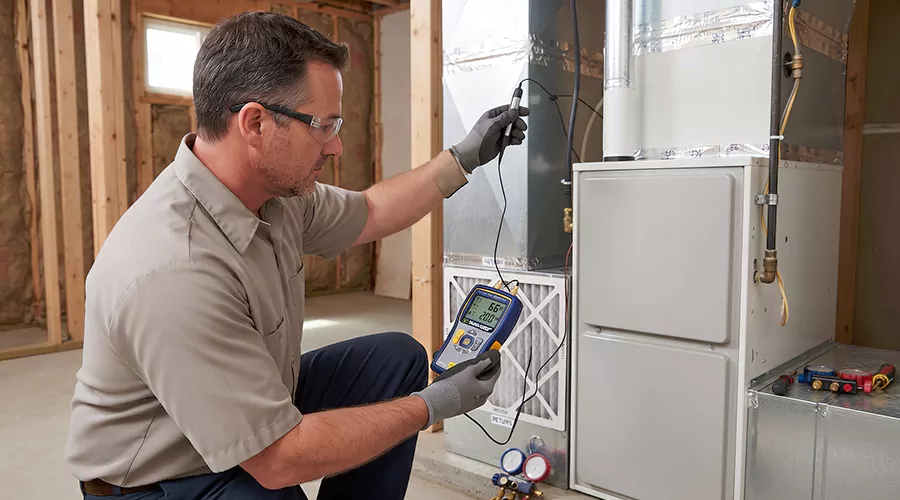
HVAC Delta T in cooling mode commonly falls between about 14°F and 23°F when measured correctly across the evaporator coil. A 20°F split is a useful rule of thumb but it is not a universal target. Indoor humidity and airflow can move the correct reading several degrees.
Delta T is the temperature difference between air entering the cooling coil and air leaving it. A reading outside the expected range can reveal an airflow or cooling-capacity problem. The number cannot identify the failed component by itself.
Knowing how to measure the split correctly matters because a bad measurement can make a healthy air conditioner look faulty.
What Is Delta T in HVAC?
Delta T means the difference between two measured temperatures. During air-conditioning operation you subtract the supply-air temperature from the return-air temperature. A 75°F return reading and a 56°F supply reading create a 19°F temperature split. Technicians use that difference as an early diagnostic measurement.
- The Greek letter delta represents change.
- The T represents temperature.
- Cooling equipment removes heat from return air as the air crosses the evaporator coil.
- Suppose return air entering the unit measures 76°F.
- Supply air leaving the coil measures 57°F.
The calculation is:
76°F − 57°F = 19°F
That 19°F reading sits inside the range commonly seen in residential cooling equipment.
HVAC School explains that a 20°F split is a traditional rule of thumb. Its field guidance places normal readings roughly between 14°F and 23°F depending on operating conditions.
The important detail is where you measure:
- A temperature taken at a distant bedroom vent has already been affected by the duct system.
- That reading is not the same as measuring directly before and after the evaporator coil.
What Should the Temperature Split Be for an AC?
A residential central air conditioner commonly shows a cooling temperature split around 15°F to 20°F at normal conditions. A broader 14°F to 23°F range can still be reasonable because humidity and airflow change the target. A fixed 20°F requirement can therefore produce a false diagnosis.
Different technical sources publish slightly different ranges. That is expected. ScienceInsights gives 15°F to 20°F as a typical residential range in its 2026 guide. HVAC School gives a broader 14°F to 23°F operating range. Recent field guidance also commonly uses 16°F to 22°F as a practical starting range. These numbers are not contradictory. They reflect different assumptions about airflow and indoor moisture.
Cooling Delta T Interpretation Guide
| Cooling Delta T | What it can suggest |
|---|---|
| Below 12°F | Significant cooling or measurement problem |
| 12°F to 15°F | Low split that deserves context |
| 15°F to 20°F | Common residential range |
| 20°F to 23°F | Can be normal under suitable conditions |
| Above 23°F | Check airflow before assuming stronger cooling |
| Above 25°F | Airflow restriction becomes more suspicious |
These numbers should be treated as diagnostic clues rather than pass-or-fail limits.
Humidity can change what the correct reading should be.
Why Isn't 20°F Always the Correct Delta T?
A 20°F split assumes operating conditions that may not exist in your home. High indoor humidity reduces the dry-bulb temperature drop because part of the AC capacity is removing moisture. Blower airflow also changes the split. Lower airflow usually produces a higher temperature difference:
- Air conditioning performs two jobs.
- It lowers air temperature.
- It also removes moisture.
- Cooling that changes temperature is called sensible cooling.
- Moisture removal uses latent capacity.
When indoor humidity is high the evaporator coil spends more of its available capacity condensing water. That leaves less capacity available for reducing the dry-bulb air temperature. The resulting temperature split can be lower even when the equipment is operating normally. HVAC School explains that higher relative humidity generally lowers the measured split. Airflow creates another major variable.
Traditional residential design assumptions often use roughly 400 CFM of airflow per ton of cooling capacity.
- Higher airflow usually lowers the temperature split.
- Lower airflow tends to increase it.
- Variable-speed systems complicate the rule even further.
- A variable blower can intentionally change airflow during operation.
- The temperature split can therefore change during the same cooling cycle.
What Does a Low Delta T Mean?
A low temperature split means the air is not losing as much sensible heat as expected while crossing the cooling coil. High humidity can cause this without a failure. Excessive airflow can also lower the split. Refrigerant or compressor problems become possibilities when operating conditions do not explain the reading.
- Suppose return air is 76°F.
- Supply air measures 66°F.
- The split is only 10°F.
- That deserves investigation.
- Start with measurement accuracy.
- A thermometer sitting against a metal register can produce a misleading result.
The system should also run long enough to stabilize before readings are taken.
- Next consider humidity.
- A humid home can produce a lower dry-bulb split because the coil is removing more moisture.
- Airflow matters too.
HVAC School explains that increasing airflow lowers the temperature split.
- A low reading can also occur when cooling capacity has fallen.
- Possible causes include refrigerant problems.
- A weak compressor can also reduce capacity.
- Dirty evaporator coil conditions can complicate the diagnosis.
- One reading should never be used to order an expensive repair.
What Does a High Delta T Mean?
A high cooling Delta T often points toward reduced airflow rather than unusually strong cooling. When less air crosses the evaporator coil each minute the remaining air becomes colder. Dirty filters or dirty coils can cause this pattern. Blower speed problems can also increase the measured split.
- Imagine return air at 76°F.
- Supply air measures 50°F.
- The split is 26°F.
- That cold supply air may initially look impressive.
- It can actually indicate a problem.
HVAC School describes high splits around 25°F or more as a strong reason to investigate airflow:
- Check the filter first.
- A heavily restricted filter reduces the amount of air passing through the coil.
- The blower wheel can also become dirty.
- The evaporator coil itself can collect debris.
- Duct restrictions can reduce airflow as well.
An air balancing HVAC evaluation can become useful when equipment airflow is acceptable but room distribution remains poor. The important insight is simple. Colder vent air does not automatically mean better cooling. Total airflow matters just as much as air temperature.
How Can a Bad Delta T Problem Progress?
An abnormal split can begin with a simple filter restriction before developing into coil freezing or equipment stress. A low split can also signal reduced refrigeration capacity before comfort noticeably fails. Continued operation under abnormal conditions can turn an inexpensive correction into a larger repair.
Delta T Progression and Planning Costs
| Stage | What you may notice | Possible cause | Typical 2026 cost |
|---|---|---|---|
| Early | Delta T moves slightly from normal | Dirty filter | Low DIY cost |
| Airflow problem | High split with weak vents | Airflow restriction | Diagnosis may be needed |
| Developing | High split plus icing | Dirty coil or blower problem | $100s possible |
| Capacity loss | Low split with long run times | Refrigerant problem | $250 to $1,500 |
| Motor problem | Abnormal airflow | Blower motor | $200 to $700+ |
| Major cooling loss | Low split with poor performance | Coil or compressor fault | $600 to $3,000+ |
Current 2026 Angi data places refrigerant leak repair around $250 to $1,500. Blower or fan motor work commonly falls around $200 to $700. Coil replacement can reach $600 to $2,400. Those prices show why the first measurement should not be treated as the diagnosis.
A dirty filter can create a temperature pattern that looks serious. A refrigeration failure can create another abnormal pattern. The test tells you where to investigate next.
10 Signs Your Delta T Reading Needs More Attention
An unusual temperature split matters most when another operating symptom appears at the same time. Compare airflow and cooling performance with the reading. Persistent comfort problems provide stronger evidence than one isolated measurement taken during unusual weather or immediately after startup.
- The cooling split stays below 12°F after the system stabilizes.
- The split repeatedly rises above 25°F.
- Airflow from several registers has become weaker.
- Ice appears around the evaporator coil area.
- The AC runs much longer than it used to.
- Indoor temperature does not reach the thermostat setting.
- The filter becomes heavily loaded with dust.
- Supply temperature changes sharply during one cooling cycle.
- Some rooms receive much less airflow than others.
- The outdoor unit runs normally while indoor cooling remains poor.
One unusual number is less informative than a repeated pattern. Measure under similar conditions when possible. Keep a record. A baseline can make future changes much easier to recognize.
How Can You Measure Delta T Yourself?
A homeowner can perform a basic temperature-split check with a digital probe thermometer. Let the AC run for about 15 minutes first. Measure return air near the equipment if safely accessible. Then measure supply air after the evaporator coil. Subtract supply temperature from return temperature.
Use a probe thermometer rather than an infrared thermometer.
HVAC School specifically warns against using infrared thermometers for this measurement because they read surface temperature rather than air temperature:
- Let the system run continuously before testing.
- Fifteen minutes is a reasonable homeowner baseline.
- Take the return-air measurement.
- Then take the supply-air measurement.
Use this formula:
Return temperature − Supply temperature = Cooling Delta T
Example:
- Return air = 77°F
- Supply air = 58°F
- Delta T = 19°F
Avoid measuring at vents on opposite ends of the house if you want an accurate equipment reading. Duct heat gain can alter the result. HVAC School recommends taking readings close to the evaporator coil while leaving enough distance for the air to mix properly. If access near the air handler requires opening an equipment panel then stop. Use accessible registers as a rough homeowner screening test instead.
Why Can Measuring at Room Vents Give the Wrong Answer?
Ducts change air temperature between the equipment and the rooms. Supply air can gain heat while traveling through a hot attic. Return air can also gain heat before reaching the coil. Measuring distant grilles therefore combines equipment performance with duct-system effects.
- This is one reason two homeowners can get different answers using the same AC model.
- The equipment itself may be operating similarly.
- Their duct conditions may differ.
- Suppose supply air leaves the air handler at 56°F.
- It reaches a bedroom register at 61°F.
- The five-degree difference occurred inside the duct path.
- Using the bedroom reading makes the equipment Delta T look lower than it really is.
- The same principle applies on the return side.
- A hot attic can influence poorly insulated return ducts.
- This does not make register measurements useless.
- They can still help compare rooms.
- They are simply less accurate for diagnosing coil performance.
How Does Airflow Affect HVAC Delta T?
Airflow and temperature split move in opposite directions under otherwise similar conditions. Increasing airflow usually lowers the split because more air crosses the coil each minute. Reducing airflow raises the split because a smaller volume of air spends more time exchanging heat with the evaporator coil.
This relationship helps explain many confusing readings.
- A dirty filter can reduce airflow.
- That can increase the split.
- A slow blower can create a similar pattern.
- Excessive blower speed can move the reading in the opposite direction.
- That creates a lower split.
Air balancing becomes relevant when airflow is distributed unevenly even though total system airflow is reasonable. The system must move the correct total amount of air. That air also has to reach the right rooms. Temperature split does not tell you both answers by itself.
When Should You Call a Professional?
Professional diagnosis makes sense when an abnormal split persists after checking the filter and measurement method. A technician can measure total airflow or static pressure. Refrigerant conditions can also be evaluated. Those measurements help separate an airflow problem from reduced cooling capacity before parts are replaced.
- Call when the evaporator coil begins freezing.
- Repeated low Delta T also deserves investigation when humidity cannot explain it.
- A split above 25°F with weak airflow deserves airflow testing.
- A professional can measure static pressure.
- Blower performance can then be compared with equipment requirements.
- Refrigeration testing can include superheat or subcooling where appropriate.
HVAC School recommends interpreting Delta T together with other measurements rather than relying on the split alone. That approach reduces unnecessary part replacement. A low split should not automatically trigger refrigerant addition. Refrigerant work also falls under federal service rules. EPA Section 608 requires certification for technicians performing covered work that can release regulated refrigerants.
How Can You Keep Delta T in a Normal Range?
Keeping the cooling system within its expected operating range starts with maintaining proper airflow. Replace a dirty filter before it severely restricts the blower. Keep supply registers unobstructed. Address coil contamination when it affects airflow. Record a normal temperature split so future changes are easier to identify.
- Check the filter regularly during heavy cooling use.
- Do not close large numbers of supply registers in an attempt to save energy.
- Keep return-air pathways open.
- Pay attention when airflow suddenly changes.
- Watch for evaporator icing.
- A frozen coil is not normal maintenance behavior.
- Use the same thermometer and measurement points when building a baseline.
- That improves comparison quality.
- Seasonal humidity can still move the reading.
- Do not expect the number to remain identical every day.
The goal is a reasonable operating range rather than one perfect number.
Conclusion
HVAC Delta T is usually around 14°F to 23°F in cooling mode but 20°F should be treated as a guideline rather than a fixed requirement. Humidity and airflow can change the correct target. Measure after the system stabilizes and use probe temperatures close to the coil when possible. This week record one normal cooling split so you have a baseline for future troubleshooting.
Frequently Asked Questions
Yes. A 20°F cooling split falls inside the common residential range. Operating conditions can still make a slightly lower or higher reading normal.
A 10°F split is lower than the usual residential range and deserves investigation. High humidity or excessive airflow can lower the reading without proving refrigerant failure.
A 25°F split can point toward reduced airflow. HVAC School recommends investigating airflow when temperature splits become unusually high.
About 15 minutes of continuous operation is a reasonable baseline. This gives the coil time to approach steady operating conditions.
Yes. A severely dirty filter can reduce airflow which usually raises the cooling temperature split. It can eventually contribute to evaporator coil freezing.
No. High humidity or high airflow can also produce a lower split. Delta T should be interpreted with airflow and refrigeration measurements before a refrigerant diagnosis is made.